
Most people assume growth hormone peptides are just a sneaky way to inject synthetic hormones into your body. That assumption is wrong, and it's costing people real results. Growth hormone secretagogues are synthetic peptides that stimulate your pituitary gland to release your own growth hormone, not a foreign substitute. This guide breaks down exactly how they work, what the research says about their benefits for muscle recovery, fat loss, and sleep, and how to use them without putting yourself at risk.
Table of Contents
- What are growth hormone peptides?
- How do GH peptides work in the body?
- Top benefits of growth hormone peptides for wellness and fitness
- GH peptides vs direct HGH: safety, efficacy, and side effects
- Risks, legal issues, and how to use GH peptides safely
- Get expert guidance and quality peptide sources
- Frequently asked questions
Key Takeaways
| Point | Details |
|---|---|
| Peptides stimulate natural GH | Growth hormone peptides trigger your own pituitary to produce growth hormone, not deliver it directly. |
| Evidence-backed benefits | Research links GH peptides to improved muscle recovery, fat loss, and wellbeing with lower risk than HGH. |
| Safety and regulation matter | Most peptides are experimental, require medical oversight, and are banned in sports, so source carefully. |
| Proper timing and cycling | For best effects, use peptides in cycles and time doses fasted and at night to mimic natural rhythms. |
What are growth hormone peptides?
Growth hormone peptides, formally called growth hormone secretagogues (GHS), are compounds designed to signal your pituitary gland to produce and release more of your own growth hormone. The key word is your own. They don't flood your system with an external hormone. They work through your body's existing machinery.
This is a fundamentally different pathway from injecting synthetic human growth hormone (HGH) directly. Understanding how peptides work makes this distinction obvious: peptides act as messengers, while direct HGH acts as a replacement.
"Growth hormone peptides, also known as growth hormone secretagogues (GHS), are synthetic peptides that stimulate the pituitary gland to release endogenous human growth hormone rather than directly supplying GH." — Growth Hormone Secretagogues: Complete Overview
Here's how GH peptides differ from direct HGH at a glance:
- GH peptides stimulate your pituitary to produce GH naturally
- Direct HGH bypasses the pituitary entirely and supplies hormone externally
- GH peptides preserve your body's natural feedback loop
- Direct HGH can suppress your body's own production over time
- GH peptides produce pulsatile (rhythmic) GH release
- Direct HGH creates a sustained, non-natural hormone elevation
The peptide effects explained in research consistently show that this messenger-based approach is what makes GHS compounds so interesting for fitness and health applications.
How do GH peptides work in the body?
Once you take a GH peptide, whether subcutaneously injected or via another route, a specific chain of events unfolds. This process is faster and more targeted than most people realize.
- Administration: The peptide enters your bloodstream and travels to the hypothalamus and pituitary gland.
- Receptor binding: It binds to specific receptors, primarily the ghrelin receptor (GHSR) or GHRH receptor, depending on the peptide class.
- Pituitary activation: The pituitary receives the signal and releases a pulse of growth hormone into circulation.
- Tissue response: GH travels to the liver and peripheral tissues, triggering IGF-1 production and downstream anabolic effects like muscle repair and fat metabolism.
- Feedback reset: Your body's natural feedback loop kicks in, preventing runaway hormone levels.
The concept of pulsatile release is critical here. Your body naturally releases GH in pulses, mostly during deep sleep and fasting. Mimicking this rhythm is healthier than a flat, sustained hormone elevation. That's why peptide receptors and their activation patterns matter so much in research.

Combining a GHRH analog (like CJC-1295) with a GHRP (like Ipamorelin) is where things get especially interesting. Combinations like CJC-1295 + Ipamorelin produce synergistic GH release exceeding individual effects by activating dual pathways and mimicking natural pulsatile secretion.
Pro Tip: Stack a GHRH analog with a GHRP rather than using either alone. The dual-pathway activation produces significantly more GH output while still respecting your body's natural feedback rhythm.
Top benefits of growth hormone peptides for wellness and fitness
The research on GH peptides points to several meaningful benefits for people focused on body composition, recovery, and long-term health. These aren't vague promises. There's actual outcome data behind the most studied compounds.
| Peptide | Primary effect | Key outcome data |
|---|---|---|
| Tesamorelin | Visceral fat reduction | 15-20% reduction in visceral fat |
| Ipamorelin | Selective GH release | Minimal cortisol/prolactin impact |
| CJC-1295 | Sustained GH elevation | Dose-dependent IGF-1 increases |
| Hexarelin | Potent GH stimulation | Strong GH pulse, some desensitization risk |
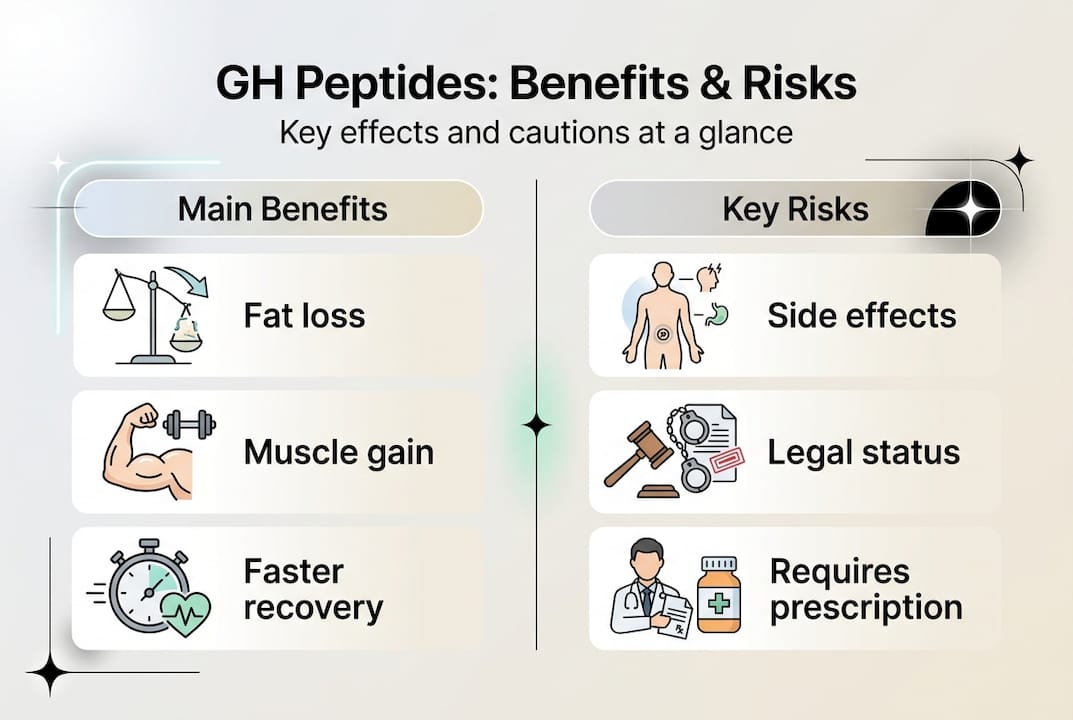
Tesamorelin reduces visceral fat by 15 to 20 percent, a figure drawn from its FDA-approved use in HIV-associated lipodystrophy. That's a clinically significant number, not a marketing claim.
Key benefits backed by research include:
- Faster muscle recovery: Elevated GH and IGF-1 accelerate protein synthesis and tissue repair after training
- Visceral fat loss: Particularly with Tesamorelin, measurable reductions in deep abdominal fat
- Muscle preservation: Used off-label for muscle preservation and recovery without suppressing natural GH feedback
- Improved sleep quality: GH pulses align with slow-wave sleep, and peptide use often improves sleep depth
- Metabolic support: Higher GH levels support better glucose metabolism and energy partitioning
For anyone focused on muscle growth peptide research or exploring peptide clinical applications, these compounds represent one of the most studied categories in the space.
GH peptides vs direct HGH: safety, efficacy, and side effects
This comparison matters because the two approaches are often lumped together, but they carry very different risk profiles.
| Factor | GH peptides | Direct HGH |
|---|---|---|
| Mechanism | Stimulates natural production | Replaces natural production |
| Feedback loop | Preserved | Suppressed |
| GH pattern | Pulsatile (natural) | Sustained (non-natural) |
| Risk of edema | Low | Moderate to high |
| Insulin resistance risk | Low | Higher with chronic use |
| Cost | Lower | Significantly higher |
| Regulation | Mostly experimental | Prescription-controlled |
"Peptides are more physiological, preserving pulsatile release and natural feedback, with lower suppression risk and lower cost. Direct HGH produces faster effects but carries risks including edema, insulin resistance, and potential cancer promotion with long-term misuse." — HGH Drug Chemistry Information
The peptide therapy benefits most people care about, including recovery, body composition, and sleep, are achievable with GH peptides at a fraction of the risk associated with direct HGH. That said, peptides are not risk-free, and they are generally less potent for acute effects. The trade-off is sustainability and physiological compatibility.
Risks, legal issues, and how to use GH peptides safely
Being informed about the downsides is just as important as knowing the benefits. Here's what you need to know before using any GH peptide.
Main risks to be aware of:
- Adulteration: Unverified suppliers frequently sell mislabeled or contaminated products
- Unapproved status: Most GH peptides are not FDA-approved for fitness or general wellness use
- Desensitization: Continuous use without cycling can reduce pituitary responsiveness over time
- Pituitary limitations: If your pituitary is already underperforming, peptides may produce limited results
- IGF-1 concerns: Chronically elevated IGF-1 has theoretical links to cell proliferation, though evidence in healthy adults is limited
On the legal side, most GH peptides are experimental and not FDA-approved for fitness use. Tesamorelin is the only FDA-approved GH peptide, and only for a specific medical condition. Every GH peptide is WADA-prohibited, meaning competitive athletes face serious consequences for use.
One important physiological note: GH declines roughly 14% per decade after age 30, a process called somatopause. This is why interest in GH peptides grows with age. But it also means results vary significantly based on your baseline pituitary function.
For peptide regulations in 2026 and a full breakdown of peptide legality, staying current with regulatory changes is essential before sourcing anything.
Pro Tip: Time your GH peptide dose in a fasted state, ideally 30 to 60 minutes before sleep. GH naturally peaks during slow-wave sleep, and fasting removes the insulin spike that blunts GH release. Cycle on for 8 to 12 weeks, then take a 4-week break to prevent desensitization.
Get expert guidance and quality peptide sources
If you're considering adding GH peptides to your wellness or research routine, the quality of your information and your sources matters as much as the compounds themselves. Poorly sourced peptides and misinformation are the two biggest risks in this space.

At pept.me, we've built a platform specifically for people who want evidence-based education on research peptides before making any decisions. You can browse research peptides organized by effect and mechanism, or explore our vetted suppliers directory to find quality-tested sources. Whether you're just starting to research GH peptides or you're ready to go deeper on specific compounds, we make it easier to move forward with confidence and clarity.
Frequently asked questions
Are growth hormone peptides safe for muscle recovery?
When sourced from reliable providers and used with medical oversight, GH peptides have a stronger safety profile than direct HGH because they preserve your body's natural feedback loop. That said, no compound is risk-free without proper supervision, as peptides carry lower suppression risk than synthetic HGH but still require responsible use.
Can I use growth hormone peptides for weight loss?
Some peptides show real results for fat loss, particularly Tesamorelin, which reduces visceral fat by 15 to 20% in clinical settings. Most GH peptides are not FDA-approved for general weight loss, so use should be approached carefully and with professional guidance.
Do growth hormone peptides require a prescription?
Yes. Most GH peptides are experimental or prescription-only, and none except Tesamorelin hold broad FDA approval. Treating them as over-the-counter supplements is both legally and medically incorrect.
What's the recommended way to cycle GH peptides?
Cycling with rest periods prevents pituitary desensitization. Timing doses when fasted and before sleep maximizes natural GH pulse alignment. An 8 to 12 week on, 4 week off structure is a commonly recommended starting framework.
Are GH peptides banned in sports?
Yes, without exception. All growth hormone peptides are prohibited by WADA and their use in competitive sports carries serious sanctions regardless of the specific compound or dose.