
Your body houses over 800 distinct peptide receptors, microscopic gatekeepers that determine whether peptides enhance your muscle growth, accelerate recovery, or optimize fat metabolism. These receptors, primarily G-protein coupled receptors (GPCRs), operate at incredibly low concentrations to trigger cascades affecting everything from hormone release to tissue repair. Understanding how peptides interact with these cellular targets transforms vague supplementation into strategic, science-informed performance enhancement. This guide breaks down receptor biology, explores mechanisms behind muscle and fat changes, and examines what current research reveals about popular peptides like BPC-157.
Table of Contents
- What Are Peptide Receptors And Why Do They Matter?
- How Peptide Receptors Influence Muscle Growth, Fat Loss, And Recovery
- BPC-157 And Peptide Therapies: What The Science Says
- Challenges, Safety, And The Future Of Peptide Receptor-Targeted Therapies
- Explore Vetted Peptide Suppliers And Research Resources
- Frequently Asked Questions
Key takeaways
| Point | Details |
|---|---|
| Receptor diversity | Over 800 GPCR types mediate peptide effects on metabolism, immunity, and tissue repair at nanomolar concentrations |
| Performance pathways | Peptide receptors trigger growth hormone and IGF-1 release, directly influencing muscle synthesis and fat breakdown |
| Evidence gaps | Most peptide benefits come from animal studies; human clinical trials remain limited despite promising observational data |
| Safety considerations | Unregulated peptide products carry contamination risks and lack rigorous safety testing in athletic populations |
| Future potential | Advances in receptor structural biology may enable personalized peptide therapies tailored to individual hormonal profiles |
What are peptide receptors and why do they matter?
Peptide receptors belong primarily to the G-protein coupled receptor superfamily, the largest membrane protein family in humans with over 800 distinct types. These receptors span cell membranes, waiting to bind specific peptide molecules that arrive at incredibly dilute concentrations, often in the nanomolar to micromolar range. When a peptide locks onto its matching receptor, it triggers intracellular signaling cascades that alter gene expression, enzyme activity, and cellular behavior within minutes.
This receptor-ligand interaction explains how peptides work at the molecular level. Unlike nutrients that provide building blocks or energy, peptides activate receptors to initiate specific biological responses. A single peptide binding event can amplify into thousands of downstream molecular changes, making these compounds remarkably potent signaling tools.
Structural studies using X-ray crystallography and cryo-electron microscopy have revealed how peptide receptors change shape upon activation, opening channels for G-proteins to relay signals inside cells. This conformational flexibility allows one receptor type to produce different effects depending on which G-protein subtype it activates, adding layers of complexity to peptide pharmacology.
For athletes and fitness enthusiasts, peptide GPCRs regulate critical physiological processes:
- Muscle protein synthesis and breakdown balance
- Growth hormone and insulin-like growth factor release
- Energy metabolism and fat oxidation rates
- Inflammatory responses and tissue repair signaling
- Vascular function and nutrient delivery to muscles
- Pain perception and recovery from training stress
Understanding which receptors a peptide targets helps predict its effects and potential side effects. Peptides with high receptor selectivity produce focused outcomes, while those binding multiple receptor types create broader but less predictable changes. This receptor specificity becomes crucial when choosing peptides for particular fitness goals like hypertrophy versus endurance.
How peptide receptors influence muscle growth, fat loss, and recovery
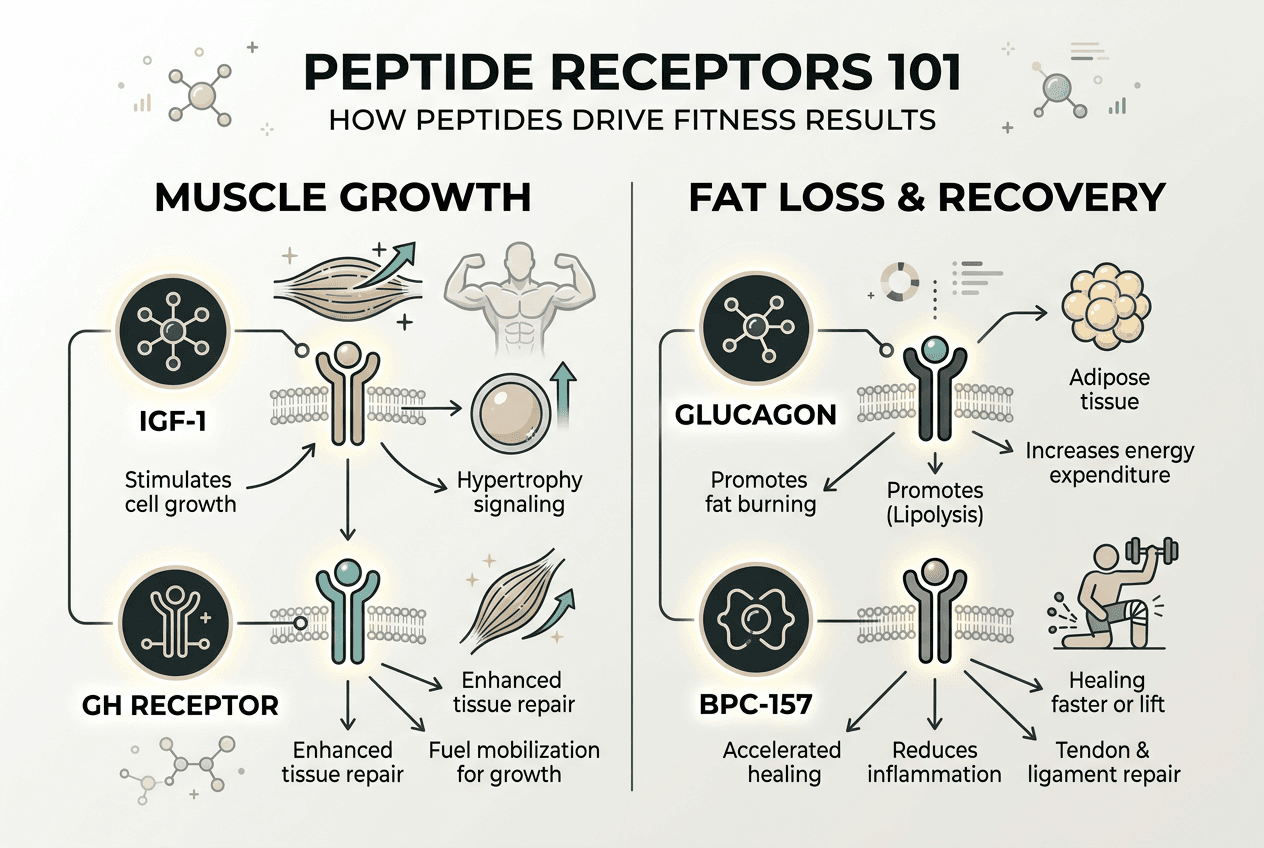
Peptide receptors translate molecular binding events into measurable changes in body composition and athletic performance through hormone signaling cascades. When growth hormone secretagogues bind their receptors, they stimulate human growth hormone release from the pituitary gland. This HGH surge then travels through the bloodstream to liver cells, where it activates IGF-1 production, the primary mediator of growth hormone's anabolic effects.
Ghrelin receptors exemplify how peptide-receptor interactions drive metabolic changes relevant to fitness. These receptors respond to both endogenous ghrelin and synthetic growth hormone secretagogues, triggering a cascade that elevates circulating HGH for several hours. The resulting IGF-1 increase promotes muscle protein synthesis while simultaneously enhancing lipolysis, the breakdown of stored fat for energy.
The receptor-mediated pathway from peptide administration to physical changes follows this sequence:
- Peptide binds to specific GPCR on target cell surface
- Receptor activation triggers G-protein signaling and secondary messenger release
- Signaling cascade reaches nucleus, altering gene transcription for growth factors
- Increased growth hormone and IGF-1 production amplifies anabolic signaling
- Enhanced muscle protein synthesis, satellite cell activation, and fat mobilization
- Accelerated tissue repair, reduced inflammation, and improved recovery capacity
Peptides like BPC-157 demonstrate receptor-mediated healing through different mechanisms. Rather than boosting hormone levels, these peptides enhance growth factor receptor expression in injured tissues, making cells more responsive to naturally circulating repair signals. This amplification effect explains why relatively small peptide doses can produce significant recovery benefits.

Receptor density and sensitivity vary across tissue types, creating opportunities for targeted effects. Muscle tissue expresses high levels of IGF-1 receptors, making it particularly responsive to growth hormone secretagogues. Adipose tissue contains different receptor profiles that respond to peptides influencing fat metabolism and thermogenesis. Understanding these tissue-specific receptor distributions helps optimize peptide effects for specific goals.
Pro Tip: Time peptide administration around workouts to maximize receptor-mediated benefits. Taking growth hormone secretagogues 30 minutes before training or immediately post-workout aligns peak peptide levels with natural hormone pulses and nutrient uptake windows, potentially enhancing muscle protein synthesis and recovery signaling.
BPC-157 and peptide therapies: what the science says
BPC-157, a synthetic peptide derived from a protective gastric protein, interacts with multiple receptor pathways to promote tissue repair and reduce inflammation. Unlike growth hormone secretagogues that work through a single receptor type, BPC-157 appears to modulate several signaling systems simultaneously, including growth factor receptors, nitric oxide pathways, and inflammatory mediators. This multi-target action may explain its broad effects on different tissue types.
Preclinical studies in rodent models have documented impressive healing outcomes:
- Accelerated tendon-to-bone healing with improved biomechanical strength
- Enhanced ligament repair following surgical transection
- Faster muscle recovery after crush injuries or toxin-induced damage
- Nerve regeneration in peripheral nerve injury models
- Reduced inflammatory cytokine levels in damaged tissues
- Protection against gastric ulcers and intestinal damage
The evidence gap between animal research and human application remains substantial. No high-quality clinical trials have evaluated BPC-157 efficacy or safety in human athletic populations. Available human data comes primarily from observational case reports and anecdotal accounts, which cannot establish causation or rule out placebo effects.
| Evidence Type | Animal Models | Human Data |
|---|---|---|
| Tendon repair | Significant improvement in healing time and strength | Case reports only, no controlled trials |
| Muscle recovery | Documented faster regeneration after injury | Anecdotal reports, unverified outcomes |
| Safety profile | No major adverse effects in preclinical toxicity studies | Unknown long-term safety in humans |
| Mechanism clarity | Well-characterized receptor and pathway effects | Assumed similar to animal models |
| Dosing guidance | Established effective ranges for rodents | Extrapolated doses, not validated |
BPC-157 metabolism involves rapid breakdown and clearance, with a half-life around 30 minutes following injection. The liver and kidneys process and eliminate the peptide quickly, reducing accumulation risks but requiring frequent dosing to maintain therapeutic levels. Preclinical safety studies have not identified significant toxicity at doses far exceeding those used for performance or recovery, but these findings may not translate directly to human use.
The peptide's mechanism involves enhancing growth hormone receptor expression and activating angiogenic pathways that increase blood vessel formation in healing tissues. This vascular enhancement improves nutrient and oxygen delivery to injured areas, potentially accelerating repair processes. BPC-157 also appears to modulate the balance between pro-inflammatory and anti-inflammatory signals, promoting resolution of acute inflammation without suppressing necessary immune responses.
For athletes considering BPC-157, understanding these mechanisms and evidence limitations proves crucial. The BPC-157 research overview shows promise for injury recovery, but gaps in human data mean effects and safety remain partially characterized. More information about practical applications appears in this BPC-157 muscle recovery guide.
Pro Tip: Given the lack of regulatory oversight and human clinical trials, source BPC-157 only from suppliers providing third-party purity testing certificates. Consult a healthcare professional familiar with peptide therapies before starting any protocol, especially if you have existing health conditions or take medications that might interact with growth factor signaling pathways.
Challenges, safety, and the future of peptide receptor-targeted therapies
Developing effective peptide therapies faces significant obstacles rooted in receptor structural complexity and signaling flexibility. Peptide GPCRs can adopt multiple active conformations, each potentially triggering different downstream pathways. This conformational promiscuity makes designing peptides with purely beneficial effects challenging, as the same receptor activation might produce desired anabolic effects alongside unwanted metabolic changes.
The current peptide landscape presents both opportunities and risks for fitness applications:
| Advantages | Disadvantages |
|---|---|
| Natural signaling mechanisms with lower immunogenicity than synthetic drugs | Lack of FDA approval for most fitness-related peptides |
| Targeted receptor activation allows specific physiological effects | Quality control issues with unregulated online suppliers |
| Rapid metabolism reduces accumulation and long-term exposure | Limited human safety data, especially for chronic use |
| Potential for fewer side effects than traditional hormone therapy | Unknown interactions with training, nutrition, and other supplements |
| Emerging evidence for recovery and injury healing applications | High cost relative to established interventions |
Safety concerns extend beyond individual peptide effects to broader issues with the unregulated peptide market. Key risks include:
- Contamination with bacterial endotoxins or heavy metals during synthesis
- Incorrect peptide sequences or concentrations due to manufacturing errors
- Lack of sterility in products intended for injection
- Mislabeling of peptide identity or purity levels
- Unknown long-term effects on hormone balance and receptor sensitivity
- Potential for developing antibodies against administered peptides
The gap between marketing claims and scientific evidence has grown as peptide availability has expanded. One expert perspective captures this disconnect:
"The expansion of online peptide vendors and direct-to-consumer marketing has dramatically outpaced the accumulation of peer-reviewed evidence supporting their use. Athletes and fitness enthusiasts are essentially conducting uncontrolled experiments on themselves, with uncertain outcomes and safety profiles."
Regulatory status adds another layer of complexity. Most peptides used for fitness and recovery exist in a gray area, neither explicitly approved for these purposes nor definitively banned. The FDA has issued warnings about certain peptides marketed as supplements, and anti-doping agencies prohibit many growth hormone secretagogues in competitive sports. Staying informed about peptide legality and safety helps avoid legal and health complications.
Future developments in peptide receptor science offer promising directions. Advances in cryo-electron microscopy now reveal receptor structures at near-atomic resolution, showing exactly how peptides bind and activate their targets. This structural knowledge enables rational design of peptides with improved selectivity and potency. Computational modeling can predict which peptide modifications might enhance desired effects while minimizing off-target activation.
Personalized peptide therapy represents another frontier. Individual variations in receptor expression, hormone levels, and metabolic profiles mean identical peptide protocols produce different results across users. Future approaches might involve baseline testing to identify which peptide receptors you express at high levels, then selecting peptides optimized for your receptor profile. This precision approach could maximize benefits while reducing trial-and-error experimentation.
For now, responsible peptide use requires careful supplier selection and ongoing education about evolving research and regulations. The peptide regulations 2026 landscape continues shifting as regulatory agencies respond to increased peptide popularity. Choosing reputable sources, verifying product purity, and monitoring your response to any peptide protocol remains essential for safe exploration of these receptor-targeted therapies.
Explore vetted peptide suppliers and research resources
Navigating the peptide landscape requires reliable information sources and access to quality-tested products. Understanding peptide receptors and their effects represents just the first step; translating that knowledge into safe, effective use demands careful supplier selection and ongoing research.
Our platform maintains a comprehensive directory of research peptide suppliers that meet strict quality standards, including third-party testing verification and transparent manufacturing practices. Each supplier undergoes evaluation for product purity, customer service, and shipping reliability to help you source peptides with confidence.
The peptide directory provides detailed profiles for dozens of peptides, covering receptor mechanisms, research findings, dosing considerations, and safety information. Whether you're exploring growth hormone secretagogues, recovery peptides, or metabolic modulators, these evidence-based guides help you make informed decisions aligned with your fitness goals.

As a trusted peptide education platform, we bridge the gap between complex receptor biology and practical application, empowering athletes and fitness enthusiasts to leverage peptide science responsibly and effectively.
Frequently asked questions
What is the main function of peptide receptors in the body?
Peptide receptors serve as cellular gatekeepers that detect specific peptide molecules and translate their presence into intracellular signals affecting gene expression, metabolism, and cellular behavior. They regulate hormone release, immune responses, tissue repair, and energy balance across virtually every organ system.
How do peptides like BPC-157 interact with these receptors?
BPC-157 binds to and modulates multiple receptor types simultaneously, including growth factor receptors and inflammatory signaling pathways. This multi-target interaction enhances angiogenesis, upregulates repair mechanisms, and reduces inflammatory signals in injured tissues, though the complete receptor profile remains under investigation.
Are peptide therapies safe and are there risks involved?
Peptide safety depends heavily on product quality, dosing, and individual health status. Preclinical studies show favorable safety profiles for many peptides, but human clinical data remains limited. Risks include contaminated products from unregulated suppliers, unknown long-term effects, potential hormone imbalances, and interactions with existing health conditions.
Can peptide receptors influence muscle growth or fat loss effectively?
Receptor-mediated pathways can significantly impact muscle growth and fat metabolism through growth hormone and IGF-1 signaling. Peptides activating these pathways show promise in animal studies and anecdotal human reports, but lack rigorous clinical trials demonstrating consistent, substantial effects in athletic populations.
What should I consider before trying peptide therapies?
Evaluate your goals, research specific peptides thoroughly, verify supplier quality through third-party testing, understand legal and regulatory status in your jurisdiction, and consult healthcare professionals familiar with peptide pharmacology. Start with conservative doses, monitor responses carefully, and maintain realistic expectations based on current evidence limitations.