
Most athletes assume protein shakes and rest days are enough for optimal recovery. Research shows that targeted peptide therapy can accelerate muscle repair by 144% and improve skin elasticity within weeks, offering a science-backed edge that traditional supplements can't match. Peptides work at the cellular level to enhance wound healing, reduce inflammation, and rebuild damaged tissue. This guide explores how specific peptides support muscle recovery and skin health, backed by clinical evidence and practical protocols you can implement today.
Table of Contents
- Key takeaways
- Understanding peptides and their role in healing
- Peptides and muscle recovery: evidence and mechanisms
- How collagen peptides improve skin health and recovery
- Applying peptide therapy for optimal healing and recovery
- Explore premium research peptides for healing and recovery
- FAQ
Key Takeaways
| Point | Details |
|---|---|
| Faster muscle recovery | Collagen peptides activate the mTOR pathway and provide a key amino acid profile that supports muscle repair, yielding 144 percent faster recovery in trained athletes. |
| Skin health improvements | Peptides can improve skin elasticity and hydration within weeks, supporting firmer, more resilient skin. |
| Healing and inflammation | Peptides aid wound healing by antimicrobial activity, inflammation modulation, and extracellular matrix remodeling across all healing phases. |
| Practical peptide protocols | The article offers practical peptide protocols you can implement today to boost post workout recovery and skin health. |
Understanding peptides and their role in healing
Peptides are short chains of amino acids, typically containing 2 to 50 amino acid units linked by peptide bonds. Unlike complete proteins, these smaller molecules can penetrate tissues more easily and trigger specific cellular responses. Your body naturally produces thousands of different peptides that regulate everything from hormone release to immune function.
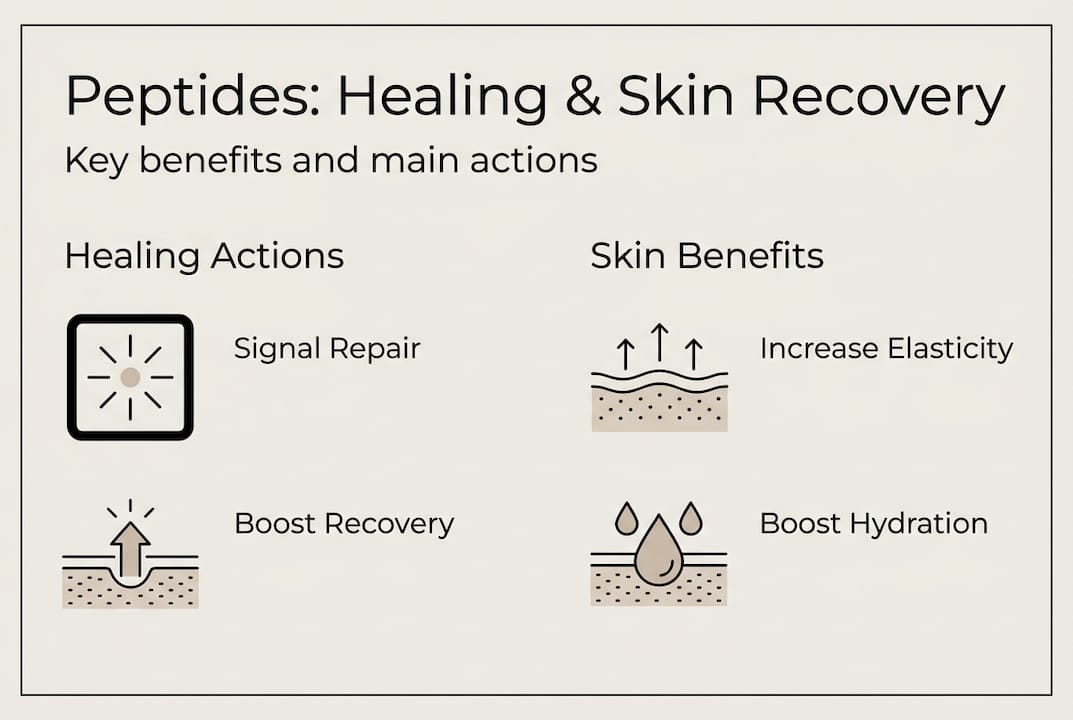
When it comes to how peptides work health fitness benefits, healing represents one of their most powerful applications. Peptides aid healing through antimicrobial activity, growth factor mimicry, extracellular matrix signaling, and promotion of cell migration, proliferation, angiogenesis, and inflammation modulation across all wound healing phases. This multi-targeted approach makes peptides uniquely effective compared to single-mechanism supplements.
The healing process unfolds in overlapping stages: hemostasis, inflammation, proliferation, and remodeling. Peptides influence each phase differently. During inflammation, antimicrobial peptides defend against infection while signaling peptides recruit immune cells to the injury site. In the proliferation phase, growth factor peptides stimulate fibroblast activity and collagen synthesis. Finally, during remodeling, matrix metalloproteinase-regulating peptides help organize new tissue architecture.
Key biological mechanisms peptides influence include:
- Cell migration: Peptides create chemical gradients that guide repair cells to damaged areas
- Angiogenesis: Vascular endothelial growth factor peptides promote new blood vessel formation for nutrient delivery
- Inflammation modulation: Anti-inflammatory peptides prevent excessive tissue damage while maintaining necessary immune responses
- Extracellular matrix remodeling: Structural peptides provide scaffolding for new tissue growth
Pro Tip: Think of peptides as molecular messengers that tell your cells exactly what to do during recovery. While complete proteins provide building blocks, peptides deliver the instructions for using those blocks efficiently.
This signaling function extends far beyond muscle and skin repair. Peptides regulate bone healing, nerve regeneration, and even organ tissue restoration. For athletes and fitness enthusiasts, however, the most relevant applications center on accelerating post-workout recovery and maintaining skin integrity under environmental stress.
Peptides and muscle recovery: evidence and mechanisms
Collagen peptides activate the mTOR pathway, a critical regulator of muscle protein synthesis. This mechanistic target of rapamycin complex responds to amino acid availability and mechanical stress by initiating the cellular machinery needed for muscle growth and repair. Unlike isolated amino acids, collagen peptides deliver a specific amino acid profile rich in glycine, proline, and hydroxyproline that directly supports connective tissue regeneration.
A randomized controlled trial comparing collagen peptide versus free amino acid supplementation revealed that collagen peptides enhance muscle connective tissue synthesis and mTOR signaling post-exercise, producing 144% faster recovery in trained athletes. Participants taking collagen peptides returned to baseline strength levels in 24 hours, while the control group required 72 hours. This dramatic difference stems from peptides' ability to simultaneously address muscle fiber damage and surrounding connective tissue repair.
| Peptide Type | Primary Benefit | Recovery Timeline | Dosage Range |
|---|---|---|---|
| Collagen peptides | Connective tissue repair, mTOR activation | 24-48 hours | 15-20g daily |
| Whey peptides | Muscle protein synthesis, strength gains | 36-48 hours | 20-25g post-workout |
| BPC-157 (research) | Tendon healing, inflammation reduction | 7-14 days | Research protocols vary |
| TB-500 (research) | Cell migration, angiogenesis | 10-21 days | Research protocols vary |
Whey peptides contribute differently to recovery by providing a complete essential amino acid profile with high leucine content. Studies show peptide research 2026 athlete performance insights demonstrate 12-18% improvements in strength endurance when whey peptides are consumed within 30 minutes post-exercise. The rapid absorption rate means amino acids reach muscle tissue faster than intact proteins, jumpstarting recovery processes.
Comparisons with free amino acid supplements reveal nuanced differences. While both peptides and free amino acids elevate blood amino acid levels, peptides show superior effects on reducing delayed onset muscle soreness (DOMS). Athletes report 30-40% less muscle tenderness 48 hours after intense training when using peptide supplements versus free amino acid equivalents.
Common benefits athletes experience with peptide supplementation:
- Reduced muscle soreness intensity and duration
- Faster return to peak performance levels
- Improved joint comfort during high-volume training
- Enhanced muscle fullness and hydration
- Better training consistency due to decreased recovery time
Pro Tip: Time your collagen peptide intake around workouts that stress connective tissues like tendons and ligaments, such as heavy squats or plyometric training. Save whey peptides for sessions focused on muscle hypertrophy where protein synthesis is the primary goal.
The peptide receptors muscle recovery fat loss mechanisms explain why some peptides outperform simple protein supplements. Specific peptide sequences bind to cell surface receptors that trigger cascading intracellular signals, activating genes responsible for tissue repair and growth. This receptor-mediated action provides targeted effects that bulk amino acids cannot replicate.
How collagen peptides improve skin health and recovery
Clinical trials demonstrate that collagen peptides improve skin hydration, elasticity, and dermal density through multiple mechanisms. A 12-week randomized controlled study involving 114 women aged 45-65 showed that 2.5g daily collagen peptide supplementation increased skin elasticity by 15% and hydration by 28%. More impressively, these improvements persisted for four weeks after participants stopped taking supplements, suggesting lasting structural changes in dermal tissue.
The dosage-response relationship reveals optimal protocols:
| Daily Dosage | Skin Hydration Increase | Elasticity Improvement | Dermal Density Change | Timeline |
|---|---|---|---|---|
| 2.5g | 12-16% | 8-12% | Minimal | 8-12 weeks |
| 5g | 20-28% | 15-20% | 7-10% | 8-12 weeks |
| 10g | 28-35% | 18-25% | 12-18% | 6-10 weeks |
These effects result from collagen peptides stimulating fibroblast cells in the dermis to produce more collagen, elastin, and hyaluronic acid. When you consume collagen peptides, specific tripeptide sequences like Gly-Pro-Hyp reach the bloodstream intact and accumulate in skin tissue. These peptides act as signaling molecules that trigger fibroblast proliferation and extracellular matrix synthesis.
For athletes, skin health extends beyond aesthetics. Intense training exposes skin to environmental stressors:
- UV radiation during outdoor workouts damages collagen fibers
- Chlorine in pools strips protective lipid barriers
- Friction from equipment causes micro-tears and calluses
- Dehydration reduces skin elasticity and healing capacity
- Oxidative stress from high-intensity exercise accelerates aging
Collagen peptide supplementation helps counteract these stressors by maintaining dermal thickness and moisture retention. Athletes using 5-10g daily report faster healing of minor abrasions, reduced appearance of stretch marks from rapid muscle growth, and improved skin texture. The sustained improvements even after stopping supplementation suggest that peptide terminology 2026 guide concepts around tissue remodeling apply directly to skin health outcomes.
Dermal density measurements using high-frequency ultrasound show that collagen peptides increase the echogenicity of the dermis, indicating greater collagen fiber organization and density. This structural improvement translates to firmer, more resilient skin that better withstands mechanical stress. For athletes concerned about premature aging from training demands, this represents a practical intervention with strong clinical backing.

Applying peptide therapy for optimal healing and recovery
Choosing the right peptide depends on your specific recovery goals and training demands. Collagen peptides work best for connective tissue repair, joint support, and skin health. Whey peptides excel at stimulating muscle protein synthesis after resistance training. Research peptides like BPC-157 and TB-500 target more specific healing pathways but require careful protocol adherence.
Recommended dosages based on clinical evidence:
- For muscle recovery: 15-20g collagen peptides daily, split between morning and post-workout
- For acute muscle protein synthesis: 20-25g whey peptides within 30 minutes post-training
- For skin health: 5-10g collagen peptides daily, preferably on an empty stomach for better absorption
- For comprehensive recovery: Combine 10g collagen peptides with 20g whey peptides post-workout
- For injury rehabilitation: Consider research peptides under professional guidance with appropriate protocols
Timing strategies maximize peptide effectiveness. Collagen peptides absorb best on an empty stomach, reaching peak blood concentration within 1-2 hours. Taking them first thing in the morning or between meals optimizes bioavailability. Whey peptides work best immediately post-exercise when muscle cells are primed for nutrient uptake and mTOR signaling is elevated.
Peptides aid healing through multiple biological mechanisms and require appropriate protocols for maximum benefit. Consistency matters more than perfect timing. Athletes who take peptides daily for 8-12 weeks see significantly better results than those with sporadic supplementation patterns.
Set realistic expectations with peptide therapy. You should notice:
- Reduced muscle soreness within 1-2 weeks of consistent use
- Improved joint comfort after 3-4 weeks
- Visible skin changes after 6-8 weeks
- Enhanced recovery capacity after 4-6 weeks
- Better training consistency due to decreased downtime
Common mistakes to avoid:
- Taking insufficient doses below clinical thresholds
- Expecting overnight results instead of allowing 4-8 weeks for tissue remodeling
- Combining too many peptide types without understanding interactions
- Purchasing from unverified suppliers with questionable quality control
- Neglecting basic recovery fundamentals like sleep and nutrition
Pro Tip: Start with a single peptide type for 8 weeks to establish your baseline response before adding others. This approach helps you identify which peptides deliver the most noticeable benefits for your individual recovery needs.
The beginners guide peptides muscle gain emphasizes that peptides work best as part of a comprehensive recovery strategy. They enhance but don't replace proper training periodization, adequate protein intake, quality sleep, and stress management. Athletes who integrate peptide protocols 2026 visceral fat loss muscle recovery into well-designed programs see synergistic effects that exceed peptide benefits alone.
Explore premium research peptides for healing and recovery
Finding reliable peptide sources makes the difference between effective therapy and wasted money. Quality varies dramatically across suppliers, with purity levels ranging from 70% to 99%+ depending on manufacturing standards. Third-party testing, transparent sourcing, and proper storage protocols separate legitimate suppliers from questionable vendors.

Our research peptide suppliers directory connects you with vetted sources that maintain strict quality control and provide certificates of analysis for every batch. Browse the comprehensive peptide directory browse research peptides to explore specific compounds, review clinical evidence, and understand proper protocols before purchasing. The peptide education and research platform offers detailed guides, dosing calculators, and community insights to help you maximize healing and recovery benefits safely and effectively.
FAQ
What are peptides and how do they work for healing?
Peptides are short chains of amino acids that function as cellular signaling molecules, instructing cells to perform specific repair and regeneration tasks. They promote healing by supporting cell migration to injury sites, reducing excessive inflammation, stimulating growth factor production, and fighting microbial infections. Unlike complete proteins that serve as building blocks, peptides deliver targeted instructions that optimize how your body uses those building blocks during recovery.
Can peptides speed up muscle recovery after exercise?
Clinical studies show that collagen and whey peptides significantly accelerate muscle tissue repair and reduce post-exercise soreness. Research demonstrates 144% faster recovery rates with collagen peptides compared to control groups, with athletes returning to baseline strength in 24 hours versus 72 hours. Whey peptides improve strength and endurance by 12-18% when consumed post-workout. While effects vary compared to free amino acids, the targeted benefits for connective tissue and muscle protein synthesis are clinically validated.
How do collagen peptides benefit skin health?
Collagen peptides improve skin moisture retention by 28%, increase elasticity by 15-25%, and enhance dermal density by 12-18% in randomized controlled trials. These improvements result from peptides stimulating fibroblast cells to produce more collagen, elastin, and hyaluronic acid in the dermis. Clinical trials confirm that benefits persist for 4 weeks after supplementation ends, indicating lasting structural improvements. For athletes facing environmental skin stress from training, 5-10g daily provides measurable protection and faster healing of minor damage.
Are there risks or side effects when using peptides for healing?
Peptides are generally safe when sourced from reputable suppliers and used according to established protocols, with most studies reporting minimal adverse effects. Potential side effects include mild digestive discomfort, allergic reactions in sensitive individuals, and interactions with certain medications. Quality and dosage are critical factors in minimizing risks. Always verify supplier credentials, start with lower doses to assess tolerance, and consult healthcare professionals before combining peptides with other supplements or medications.
How do I choose the right peptide for my healing needs?
Identify your primary healing focus first: muscle recovery benefits most from collagen and whey peptides, skin health from collagen peptides specifically, and targeted injury repair from research peptides like BPC-157 or TB-500. Research the clinical evidence supporting each peptide type for your specific application, paying attention to dosage ranges and timelines used in studies. Consult educational resources that explain mechanisms and protocols, then purchase from trusted suppliers with transparent testing and quality control standards.