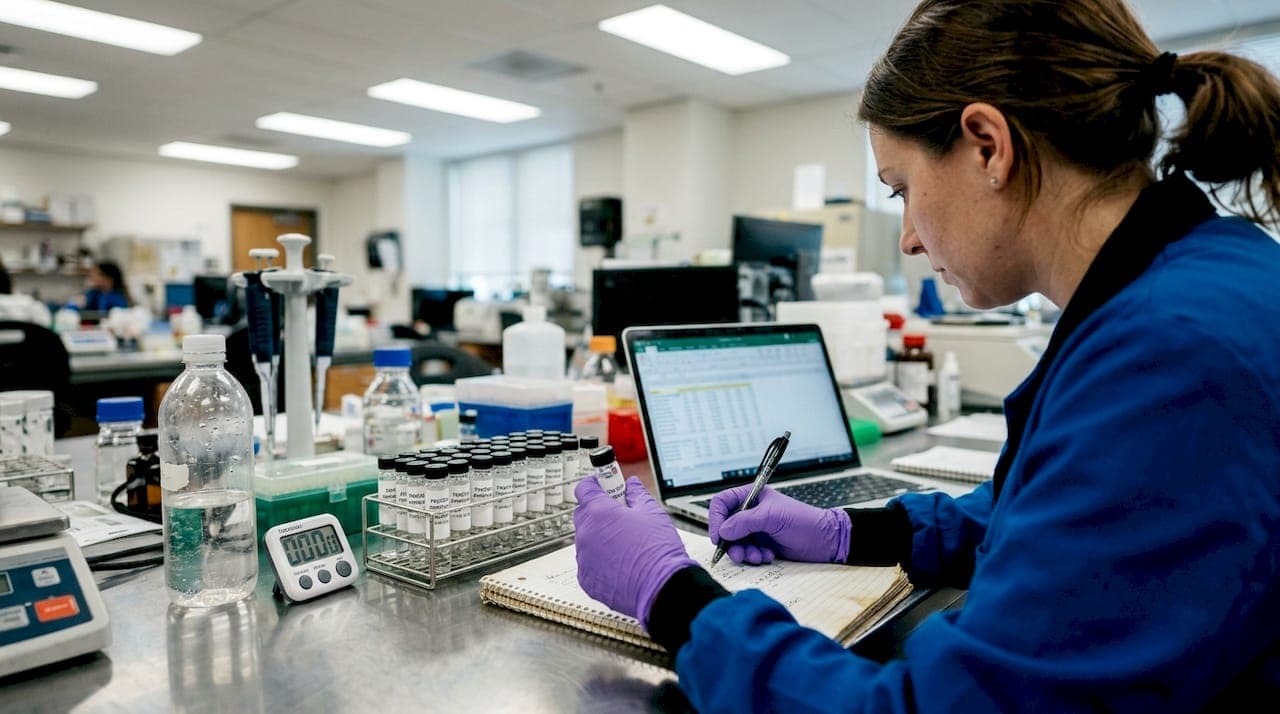
Not all peptides deliver the same results, and the reason often comes down to one overlooked factor: how they were analyzed before you ever used them. Fitness enthusiasts, skin health researchers, and wellness-focused individuals are flooding the market with demand, but far too many products ship without rigorous verification. Understanding peptide analysis methods isn't just for lab scientists. It's a practical skill that helps you separate real, potent compounds from underdosed or mislabeled ones. This article breaks down the core analysis techniques, compares them side by side, and gives you actionable steps to verify quality before committing to any peptide protocol.
Table of Contents
- What are peptides and why is analysis vital?
- Core methods for peptide analysis explained
- Comparing peptide analysis methods: which is best?
- Ensuring quality: how to verify peptide sources and results
- Why rigorous peptide analysis matters more than ever
- Find trusted peptide analysis and reliable suppliers
- Frequently asked questions
Key Takeaways
| Point | Details |
|---|---|
| Peptide quality depends on analysis | Accurate analysis ensures peptides are safe and effective for your fitness, health, or skincare goals. |
| Know the main testing methods | High-Performance Liquid Chromatography and Mass Spectrometry are industry standards for verifying peptide identity and purity. |
| Reputable sources matter | Always use peptides from trusted suppliers with transparent, third-party testing results. |
| Compare methods for your needs | Choose analysis techniques based on your purpose, budget, and desired reliability. |
What are peptides and why is analysis vital?
Peptides are short chains of amino acids, typically between 2 and 50 amino acids long, that act as biological messengers in the body. They're smaller than proteins but carry significant signaling power. In research and applied fitness contexts, peptide clinical applications span everything from stimulating growth hormone release to accelerating tissue repair and improving skin elasticity.
Peptides support muscle growth, skin repair, and enhance overall wellness, but only when the compound you're working with is actually what it claims to be. This is where analysis becomes non-negotiable. A peptide that's 70% pure instead of 98% pure won't just underperform. It may introduce unknown byproducts that could affect your results in unpredictable ways.
Here's why rigorous analysis matters at every stage:
- Identity confirmation: Verifying the peptide sequence is exactly what's labeled
- Purity assessment: Measuring how much of the product is the active compound versus impurities
- Potency testing: Confirming biological activity matches expected benchmarks
- Stability checks: Ensuring the peptide hasn't degraded during storage or shipping
- Contamination screening: Detecting residual solvents, heavy metals, or microbial content
Without these checks, you're essentially guessing. The advances in peptide therapeutics field has made it clear that even minor structural variations in a peptide can dramatically alter its effect on the body.
"A peptide that passes rigorous analysis isn't just safer. It's a fundamentally different product from one that hasn't been tested at all."
The economic stakes are real too. The global peptide market is growing rapidly, and with that growth comes a surge of low-quality products targeting uninformed buyers. Suppliers who skip analysis cut costs but pass the risk directly to you. For anyone serious about fitness, skin improvement, or health optimization, understanding what good analysis looks like is your first line of defense.
Pro Tip: Always ask for a Certificate of Analysis (COA) before purchasing any peptide. A legitimate supplier will provide one without hesitation.
Core methods for peptide analysis explained
With a clear understanding of why peptide analysis is crucial, let's explore how these methods actually work. Different analysis techniques can determine peptide identity, purity, and potency, and each method has a specific role in the quality assurance process.
Here's a comparison of the four primary methods used in professional peptide analysis:
| Method | What it measures | Speed | Skill required |
|---|---|---|---|
| HPLC | Purity and concentration | Moderate | Moderate |
| Mass Spectrometry | Exact molecular identity | Moderate | High |
| Electrophoresis | Size and charge separation | Fast | Low to moderate |
| Immunoassay | Biological activity | Fast | Low |
Let's walk through each one:
-
High-Performance Liquid Chromatography (HPLC): The sample is dissolved and pushed through a column under high pressure. Different compounds separate based on their chemical properties. The output is a chromatogram showing peaks that correspond to the peptide and any impurities. HPLC is the gold standard for purity testing and is used in nearly every professional lab.
-
Mass Spectrometry (MS): The peptide is ionized and its mass-to-charge ratio is measured. This gives you an exact molecular fingerprint. MS can confirm the peptide sequence down to single amino acid differences. It's the most precise method for identity confirmation.
-
Electrophoresis: Peptides are separated in a gel matrix using an electric field. Smaller or more charged molecules move faster. This method is faster and cheaper but less precise than HPLC or MS. It's useful for quick screening.
-
Immunoassays: These use antibodies to detect specific peptides. They're fast and can be adapted for at-home or field use, but they only tell you whether a target peptide is present, not how pure or potent it is.
For anyone following safe peptide use steps, understanding which method your supplier uses matters. The analytical techniques for peptides literature confirms that combining HPLC with MS gives the most complete picture of quality.

Pro Tip: When reviewing a COA, check whether HPLC purity is reported as area percent. A value below 95% should prompt further questions about the product's suitability for your research.
Comparing peptide analysis methods: which is best?
After learning each core method, it's vital to compare them for real-world needs. Some techniques are optimized for purity while others assess performance or biological activity, which means the "best" method depends entirely on your goal.
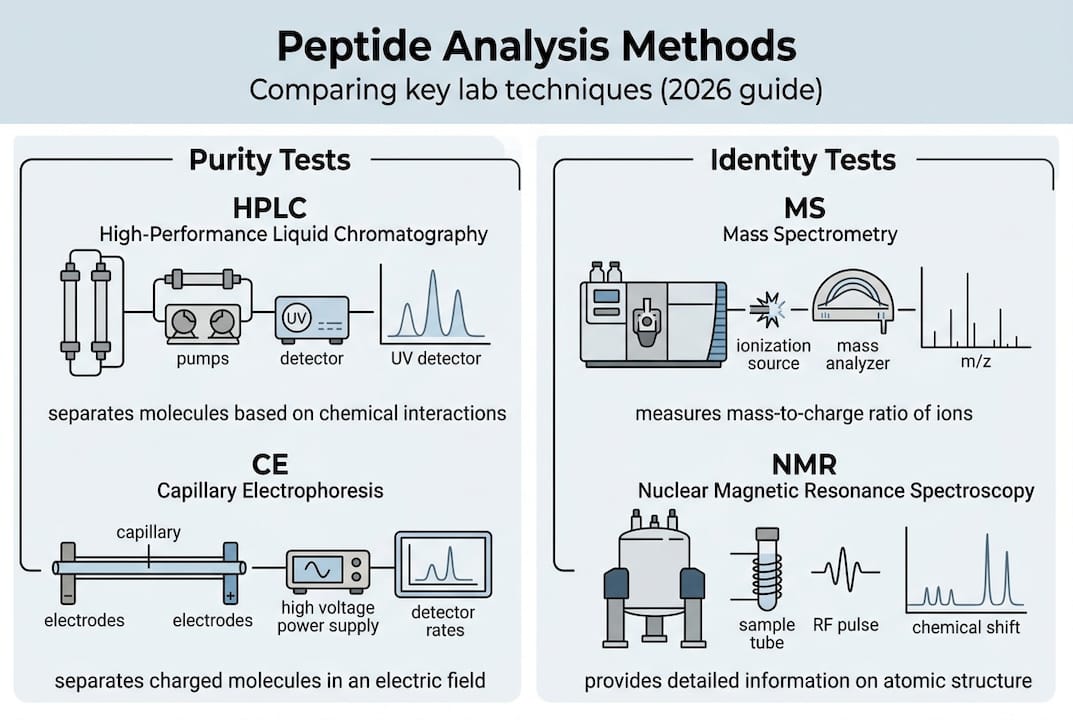
Here's a practical side-by-side comparison:
| Method | Cost | Sensitivity | False positive rate | Best for |
|---|---|---|---|---|
| HPLC | Moderate | High | Low | Purity verification |
| Mass Spectrometry | High | Very high | Very low | Identity confirmation |
| Electrophoresis | Low | Moderate | Moderate | Quick screening |
| Immunoassay | Low to moderate | Moderate | Higher | Biological activity |
Quick immunoassay kits can show false positive rates as high as 15 to 20% in uncontrolled conditions, while lab-based MS methods drop that figure to under 1%. That gap is enormous when you're making decisions about your health or athletic performance.
Here's how to match the method to your situation:
- Athletes screening for banned substances: You need MS or HPLC. Immunoassays aren't reliable enough for anti-doping purposes.
- Skincare researchers verifying ingredient purity: HPLC is the standard. It confirms concentration and flags degradation products.
- General wellness users checking product authenticity: A COA combining HPLC and MS from an independent lab is your benchmark.
- Budget-conscious buyers doing initial screening: Electrophoresis or immunoassay can flag obvious problems, but always follow up with lab-based confirmation.
For peptide analysis for athletes, the stakes are especially high. A false negative on a banned compound or a false positive on a legitimate one can have serious consequences. The future of peptide therapeutics research points toward multi-method approaches becoming the new standard, combining at least two independent techniques for any quality-critical application.
The clinical application comparisons across fitness and health contexts consistently show that buyers who understand these distinctions make better purchasing decisions and get more consistent results.
Ensuring quality: how to verify peptide sources and results
Once you've grasped the analysis methods and how they compare, the next step is ensuring you're actually getting what was promised. Knowing the science is only half the job. Applying it to your buying process is where it pays off.
Follow these steps to verify quality at every stage:
-
Before buying: Request the COA upfront. Confirm it was issued by an independent third-party lab, not the supplier's in-house team. Check the date. A COA older than 12 months may not reflect the current batch.
-
Review the COA carefully: Look for HPLC purity above 95%, MS confirmation of the correct molecular weight, and absence of residual solvents or heavy metals. If any of these are missing, ask why.
-
Cross-reference the supplier: Use vetted peptide suppliers directories to check whether the source has a track record of transparency. Community reviews and third-party audits matter.
-
After receiving the product: Check physical appearance. Lyophilized peptides should be a white or off-white powder. Discoloration, clumping, or unusual odor are red flags.
-
Document your results: Track your protocol, dosing, and observed outcomes. This creates a feedback loop that helps you identify whether a batch is performing as expected.
Reputable suppliers undergo third-party testing to verify quality and authenticity, and they make those results available without you having to ask twice. The FDA peptide guidance also highlights that consumers should be cautious of products making unverified health claims.
"Transparency isn't a bonus feature from a good supplier. It's the baseline expectation."
Red flags to watch for include prices significantly below market average, no COA available, vague ingredient labeling, and suppliers who deflect or delay when asked for documentation. You can also browse research peptides on curated platforms that pre-screen for these quality indicators.
Pro Tip: Save every COA you receive in a dedicated folder. If you ever experience inconsistent results between batches, comparing COAs is the fastest way to identify what changed.
Why rigorous peptide analysis matters more than ever
We've seen a lot of products come through the research space, and the pattern is consistent. The buyers who get reliable results aren't necessarily the ones spending the most. They're the ones who ask the right questions before they buy.
The explosion of unverified peptide products online has created a market where hype travels faster than evidence. Flashy branding and bold claims are cheap. A verified COA from an independent lab is not. That asymmetry is exactly where uninformed buyers get hurt.
Here's the uncomfortable truth: a poorly analyzed peptide doesn't just fail to work. It can actively mislead your research. You adjust your protocol, increase your dose, blame your diet, and never realize the compound itself was the problem. Rigorous peptide research evidence consistently shows that quality-verified peptides outperform unverified ones not because of magic, but because you're actually getting what you paid for.
In the long run, investing in quality-analyzed peptides saves time, money, and protects your health. Transparency and evidence aren't just nice to have. They're the foundation of any serious peptide research practice.
Find trusted peptide analysis and reliable suppliers
If you're ready to make sure your peptide journey is built on quality and transparency, here's how Pept can help.

Pept brings together a curated directory of trusted peptide suppliers who meet rigorous quality and documentation standards. Whether you're sourcing peptides for muscle growth research, skin health applications, or general wellness protocols, you can browse the peptide directory to find verified options with COAs and third-party testing already in place. For deeper learning, the Pept education hub covers everything from beginner guides to advanced research breakdowns. Stop guessing about what's in your peptides and start building your protocol on a foundation that holds up.
Frequently asked questions
Which analysis method gives the most accurate peptide results?
Mass spectrometry provides precise peptide analysis and is typically the most accurate for confirming exact peptide identity and purity when performed professionally.
How can I verify the peptides I purchase are authentic?
Check for third-party lab reports, supplier certifications, and look for products listed in reputable peptide directories. Reputable suppliers undergo third-party testing and make results available on request.
What red flags should I avoid when buying peptides?
Avoid products lacking analysis certificates, those with prices far below market average, or suppliers unwilling to provide test results. The FDA consumer updates on peptide products flag missing certificates and suspiciously low prices as key warning signs.
Can I analyze peptides at home or do I need a lab?
Certain basic tests can be done at home, but reliable peptide analysis for confirming identity and purity requires professional laboratory methods.